Punjabi is one of the world's most spoken languages — yet outside South Asia and the diaspora, it is surprisingly little understood. For UK institutions such as the Home Office, UKVI, the NHS, and the courts, Punjabi documents arrive in two entirely different scripts, from two different countries, carrying the weight of one of history's richest linguistic traditions. Understanding that context is not merely academic; it is essential for accurate, certified translation.
This article explores the origins, history, demography, and dual-script nature of Punjabi — and explains why specialist knowledge is indispensable when translating Punjabi documents in the United Kingdom.
Ancient Origins of the Punjabi Language
Punjabi belongs to the Indo-Aryan branch of the Indo-European language family. It descends from Sanskrit through a series of Prakrits and Apabhramsha dialects that evolved across the Indian subcontinent over several millennia. The name "Punjabi" is derived from the Persian words panj (five) and āb (water), referring to the five rivers — the Jhelum, Chenab, Ravi, Beas, and Sutlej — that define the Punjab region.
The Punjab itself straddles the present-day border of Pakistan and India, making it a zone of extraordinary cultural and linguistic confluence. Sitting at the crossroads of Central Asia, Persia, and the Indian subcontinent, the region was traversed by traders, soldiers, mystics, and conquerors for thousands of years. The Punjabi language absorbed and synthesised elements from all of them.
The name "Punjab" comes from Persian and means "Land of Five Rivers." This geographic identity has shaped Punjabi culture, poetry, and language for over three millennia — and explains its extraordinary borrowings from Persian, Arabic, Turkish, and Sanskrit.
A 3,000-Year History
The Vedic and Medieval Periods
The earliest traces of what would become Punjabi can be found in the Vedic Sanskrit texts composed in the Punjab region from around 1500 BCE. Over subsequent centuries, local vernacular speech diverged from classical Sanskrit, producing a series of regional Prakrits. By the medieval period, these had evolved into a recognisable early form of Punjabi, heavily influenced by the literary tradition of the Sufi orders and the Nath yogis who composed devotional poetry in the common tongue rather than the scholarly languages of the elite.
One of the earliest Punjabi literary works is the Heer Ranjha, a tragic romance composed by Waris Shah in 1766 that remains one of the great classics of Punjabi literature. But the tradition of Punjabi poetry stretches back further still, to the Kafi poetry of Sufi saints such as Bulleh Shah (1680–1757) and Baba Farid Ganj Shakar (1173–1266), whose verses appear in the Sikh scripture, the Guru Granth Sahib.
The Sikh Era and Gurmukhi's Emergence
A decisive moment in Punjabi linguistic history came with the rise of Sikhism in the 15th century. Guru Nanak Dev Ji (1469–1539), the founder of Sikhism, composed scripture in Punjabi rather than Sanskrit or Persian, making the divine accessible to ordinary people. His successor, Guru Angad Dev Ji (1504–1552), is credited with standardising and popularising the Gurmukhi script — the script of the Gurus — as the canonical written form for Sikh religious texts. The compilation of the Guru Granth Sahib in 1604 by Guru Arjan Dev Ji cemented Gurmukhi as the sacred and literary script of Punjabi-speaking Sikhs.
Mughal Influence and Shahmukhi
During the Mughal period, Persian was the language of administration, culture, and prestige across the subcontinent. Punjabi Muslims, immersed in the Persian-Arabic literary tradition, began writing their language in a modified Perso-Arabic script that came to be known as Shahmukhi — literally "from the mouth of the Shah." This script, written right-to-left, uses the same foundational alphabet as Urdu but with additional letters to represent sounds unique to Punjabi. Sufi poets, folk singers, and court scholars all contributed to a rich Shahmukhi literary tradition that ran in parallel with Gurmukhi throughout the medieval and early modern periods.
Partition and its Consequences
The Partition of British India in 1947 had a profound and lasting impact on the Punjabi language. The Punjab was divided along religious lines: the western portion became part of Pakistan (predominantly Muslim) and the eastern portion remained in India (predominantly Sikh and Hindu). This division formalised a de facto bifurcation in Punjabi literacy: in Pakistan, Punjabi is written almost exclusively in Shahmukhi; in India's Punjab state, Punjabi is written in Gurmukhi and holds official status alongside Hindi.
Partition also triggered one of the largest mass migrations in human history — an estimated 14 million people displaced across the new border — and sowed the seeds of the global Punjabi diaspora that would eventually reach the United Kingdom in large numbers.
Two Scripts, One Language
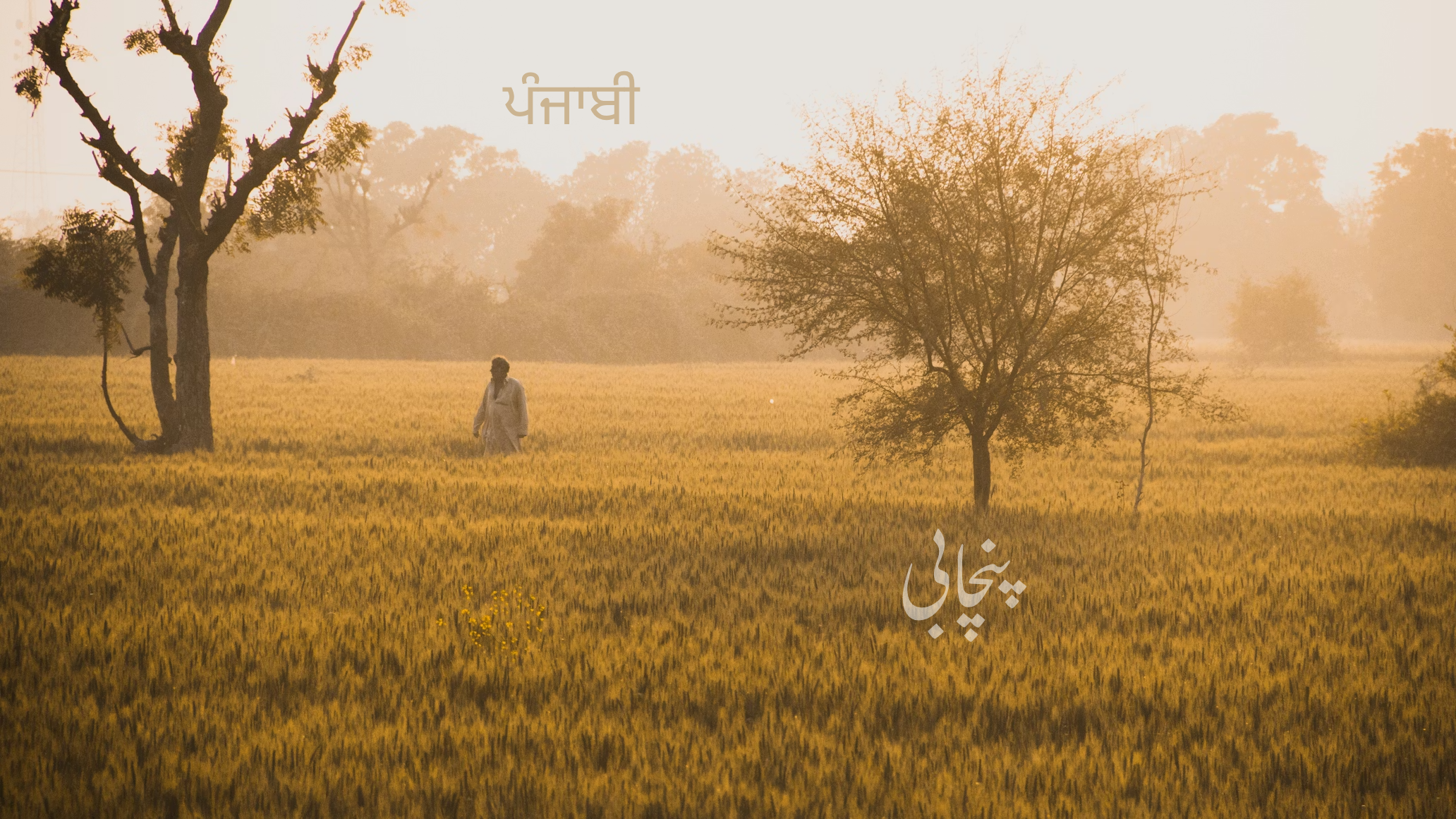
Perhaps the most distinctive — and practically significant — feature of Punjabi is that it is routinely written in two completely different scripts, each associated with a different religious and geographic community.
These two scripts are not merely different typefaces for the same content — they reflect different writing directions (Gurmukhi: left-to-right; Shahmukhi: right-to-left), different phonological conventions, different cultural resonances, and different literary traditions. A translator who reads only Gurmukhi cannot necessarily read Shahmukhi, and vice versa.
Gurmukhi Script: The Script of the Gurus
Gurmukhi is an abugida — a syllabic script in which consonants carry an inherent vowel sound, with diacritical marks used to modify or cancel it. It has 35 base consonants (the paintī), 10 vowel characters, and a set of additional markers for nasalisation, aspiration, and the Gurmukhi lāṁ vowel. It is written left-to-right, in a flowing cursive style characterised by a horizontal headstroke (the ṭopī) that links most characters.
Gurmukhi is the sole official script of Punjabi in the Indian state of Punjab, and is used in all government documents, education, media, and signage there. It is the script used in the Guru Granth Sahib, and proficiency in Gurmukhi is central to Sikh religious practice. In the UK, the vast majority of Punjabi documents arriving from India — birth certificates, marriage certificates, academic transcripts — are written in Gurmukhi.
Shahmukhi Script: The Perso-Arabic Tradition
Shahmukhi is derived from the Nastaliq style of Perso-Arabic script, the same calligraphic tradition used for Urdu. It is written right-to-left and uses a set of letters adapted from the Arabic alphabet, supplemented by characters borrowed from Persian and Sindhi to represent sounds specific to Punjabi — including the aspirated consonants (bh, ph, th, etc.) that are highly characteristic of the language.
Shahmukhi is the dominant script for Punjabi in Pakistan, where it appears in newspapers, literature, music, and increasingly in digital media. However, Punjabi has no official status at the federal level in Pakistan — Urdu is the national language — and Punjabi is not taught in most Pakistani schools. This means that many Punjabi speakers in Pakistan are functionally literate only in Urdu or Shahmukhi Punjabi, and that official documents from Pakistan (passports, birth certificates, court orders, police records) are predominantly written in Urdu, with Punjabi proper names and some regional terminology woven in.
Key point for UK visa applications: Documents from Pakistan are almost always in Urdu (Nastaliq script), not Punjabi/Shahmukhi. Documents from Indian Punjab arrive in Punjabi/Gurmukhi. These are two entirely different translation tasks requiring different specialist expertise.
Global Demography: 125 Million Speakers
Punjabi is consistently ranked among the top ten most spoken languages in the world by native speakers, with estimates ranging from 100 to 130 million depending on how diaspora communities and bilingual speakers are counted. The vast majority of native speakers — roughly 60–70 million — are in Pakistan's Punjab province, which is the most populous province in that country. A further 30–35 million are in the Indian state of Punjab, with significant populations in Haryana, Delhi, and other Indian states. The remainder form the global Punjabi diaspora.
The Punjabi Diaspora
The Punjabi diaspora is among the world's most widely dispersed. Significant communities exist in the United States (particularly California), Canada (especially British Columbia and Ontario), Australia, the United Arab Emirates, and across East Africa. But no country outside South Asia has a larger or more culturally prominent Punjabi community than the United Kingdom.
Punjabi migration to Britain began in earnest in the 1950s and 1960s, when post-war labour shortages led the British government to recruit workers from Commonwealth countries. Many of these early migrants were Punjabis — both Sikhs from Indian Punjab and Muslims from Pakistani Punjab — who settled primarily in the industrial cities of the Midlands and the North, including Birmingham, Leeds, Bradford, Leicester, Wolverhampton, and Coventry.
Punjabi in the United Kingdom
Today, Punjabi is one of the most widely spoken languages in the UK. The 2021 Census for England and Wales recorded Punjabi as the third most spoken language after English and Polish (for those who speak English as a second language), with approximately 1.5 million speakers. This figure encompasses both Gurmukhi-literate Punjabi Sikhs (predominantly of Indian heritage) and Shahmukhi/Urdu-literate Punjabi Muslims (predominantly of Pakistani heritage).
The Punjabi community in Britain is diverse, well-established, and now largely British-born. Third and fourth generation Punjabi-British citizens may have varying degrees of fluency in Punjabi, but they maintain strong cultural connections, and Punjabi continues to be spoken at home, in gurdwaras and mosques, and in community settings. The British Asian music scene, British Punjabi comedy, and the global bhangra genre have all contributed to keeping Punjabi vibrant in the UK cultural landscape.
Institutional Significance
The scale of the Punjabi-speaking community in the UK has important implications for public services. NHS trusts across the Midlands and the North regularly require Punjabi interpreters for GP appointments, hospital consultations, and mental health assessments. Courts in Birmingham, Bradford, and other cities handle cases involving Punjabi-speaking witnesses and defendants. The Home Office and UKVI process thousands of visa and immigration applications each year that involve Punjabi documents — whether Gurmukhi birth certificates from India or Urdu/Punjabi court orders from Pakistan.
Need a Certified Punjabi Translator?
Gurmukhi or Shahmukhi — we translate both. CIOL-certified, accepted by the Home Office and UKVI.
Why This Matters for UK Translation
The complexity of Punjabi's dual-script tradition, its long history of literary borrowing, and the specific document landscape faced by Punjabi speakers in the UK create a set of translation challenges that require genuine specialist expertise. Here is what practitioners and institutions need to understand.
Script Specificity is Non-Negotiable
A translator who is fluent in spoken Punjabi but reads only one script cannot accurately translate documents in the other. Gurmukhi and Shahmukhi are not interchangeable; a Gurmukhi-literate translator cannot be expected to render a Shahmukhi text accurately, and vice versa. When commissioning certified translation of Punjabi documents, always specify the script and verify the translator's credentials in that script specifically.
Punjabi and Urdu Are Not the Same Language
This is a common and costly misconception. While Punjabi Muslims in Pakistan often use Urdu for formal written communication, and while there is significant lexical overlap between the two languages in their formal registers, Punjabi and Urdu are distinct languages. A certified Urdu translator is not automatically qualified to translate Punjabi documents. The phonology, grammar, vocabulary, and idiomatic expressions differ considerably, especially in informal, regional, or dialectal usage.
Regional Dialects and Register
Standard Punjabi — whether in Gurmukhi or Shahmukhi — is the literary and formal register taught in schools and used in official documents. However, Punjabi has a rich array of regional dialects, including Majhi (considered the prestige dialect, spoken around Lahore and Amritsar), Doabi, Malwai, Pwadhi, Pothohari, and others. Each has its own phonological and lexical quirks. Documents produced in regional settings — police reports, land records, family court filings — may reflect local dialect features that a translator unfamiliar with that region might misinterpret.
Historical Documents and Name Romanisation
Older documents — particularly those produced before the widespread standardisation of transliteration conventions — may romanise Punjabi names in inconsistent or archaic ways. A birth certificate from Lahore in the 1970s might spell the same name differently from a contemporary passport. A skilled translator must navigate these inconsistencies and produce a certified translation that accurately reflects the original while noting any discrepancies.
Sikh Religious Terminology
Sikh community documents — including those from gurdwaras, Anand Karaj (marriage) certificates, Amrit Sanchar records, and SGPC (Shiromani Gurdwara Parbandhak Committee) letters — contain a significant amount of Gurbani-derived vocabulary and honorific conventions that require specialised knowledge. Terms such as Waheguru, Singh, Kaur, Dastar, and Langar carry specific cultural and religious meanings that must be handled with sensitivity and precision.
Getting Certified Punjabi Translation Right in the UK
For visa applications, immigration proceedings, legal cases, and NHS referrals, certified translation is not merely a formality — it is a legal document in its own right. The Home Office and UKVI require that certified translations be produced by a professional translator who is competent in both languages and can sign a declaration of accuracy. Rejections on the basis of poor or unqualified translation are common, and they can cause significant delays, financial loss, and distress.
When seeking certified Punjabi translation for UK institutions, look for a translator or agency that can demonstrate the following:
- Membership of a recognised professional body such as the Chartered Institute of Linguists (CIOL) or the Institute of Translation and Interpreting (ITI)
- Specific proficiency in the relevant script — Gurmukhi for Indian documents, Shahmukhi or Urdu for Pakistani documents
- Familiarity with UK institutional requirements, including the specific wording and format expected by UKVI and the Home Office
- A clear certificate of accuracy signed by the translator, including their full name, professional membership number, and contact details
- Transparency about turnaround times and processes, so you are not left waiting without updates at a critical stage of your application
At Metaphrase Ltd, our certified Punjabi translators are CIOL-accredited and experienced in both Gurmukhi and Shahmukhi translation. Every certified translation comes with a signed declaration of accuracy and is formatted to meet UKVI, Home Office, and court requirements. Learn more about our Punjabi translation service.
The Importance of a Living Language
Punjabi is not a static artefact — it is a living, evolving language spoken by over 125 million people and deeply embedded in UK life. It carries within it centuries of poetry, faith, migration, and resilience. When Punjabi documents arrive at a Home Office caseworker's desk or a hospital reception, they represent real lives and real stories. The quality of their translation matters.
Whether you need a birth certificate translated from Gurmukhi, a marriage certificate rendered from Shahmukhi, or an interpreter for a legal hearing or NHS appointment, working with a qualified Punjabi linguist is not a luxury — it is a necessity.