Professional certified Urdu–English translation for official documents — accepted by the Home Office, UKVI, UK courts, universities, and the NHS. Handled by CIOL-certified translators with over a decade of experience in Urdu legal, immigration, and official documents. Serving clients across the UK.
Metaphrase Ltd provides certified Urdu translation services to clients across the UK. With over ten years of hands-on experience and CIOL-certified translators holding the highest professional designation for linguists in the UK, we deliver accurate, accepted translations for immigration, legal, medical, and commercial purposes. We work with clients in Birmingham, Bradford, Manchester, London, Luton, and across the UK.
Urdu is Pakistan's national language and one of the most widely spoken languages in the UK. Official Pakistani documents — from NADRA birth certificates and Union Council marriage records to court orders from provincial courts — are issued in formal Urdu, a register that draws heavily on Persian and Arabic vocabulary and uses the Nastaliq calligraphic script. This formal register is quite distinct from everyday spoken Urdu and requires genuine specialist knowledge to translate accurately.
Every certified Urdu translation we produce is accompanied by a signed certificate of accuracy and has been accepted, without issue, by the Home Office, UKVI, UK courts, the NHS, and British universities. Send us your Urdu documents today and receive a certified translation within hours.
From Pakistan, India, and the Urdu-speaking diaspora worldwide
A certified Urdu translation is not simply a translation of your document. It is a complete, word-for-word English rendering of the original Urdu text, accompanied by a formal statement — known as a certificate of accuracy — signed by the translator. That certificate confirms three things: that the translator is competent in both Urdu and English, that the translation is a true and complete representation of the original document, and that the translator accepts professional responsibility for its accuracy.
The certificate of accuracy includes the translator's full name, professional credentials or membership of a recognised professional body, contact details, signature, and the date of certification. At Metaphrase, our certificates also include our ICO registration number and confirmation that the translation was completed by a CIOL-certified translator.
This certification is what distinguishes a translation accepted by the Home Office, UKVI, and UK courts from one that is not. Machine translation does not meet this standard. Nor does a translation produced by a bilingual friend or family member. Official bodies require professional certification, and the consequences of submitting a non-certified translation can be severe: delays, refusals, or having to restart an application entirely.
If you are in any doubt about whether your translation needs to be certified, the answer is almost certainly yes — particularly for immigration, legal, medical, and academic purposes. For a fuller explanation, read our guide to certified Urdu translation in the UK.
CERTIFICATE OF ACCURACY
Certified Translation — Urdu to English
I, [Translator Name], Chartered Linguist (MCIL), Member of the Chartered Institute of Linguists, hereby certify that I am competent to translate from Urdu into English and that the attached translation is, to the best of my knowledge and belief, a complete and accurate rendering of the original Urdu-language document.
We handle the full range of certified and professional Urdu translation needs — from single-page documents to complex multi-document immigration cases.
Word-for-word certified translations with a signed certificate of accuracy. Accepted by UKVI, the Home Office, UK courts, universities, and the NHS.
All documents required for UK visa and immigration applications — birth certificates, Nikkahnamas, passports, police clearances, and more.
Urdu document translation for Crown Court, Magistrates Court, employment tribunals, family proceedings, and solicitor instruction.
Patient records, clinical correspondence, referral letters, and consent forms for NHS trusts and GP practices serving Urdu-speaking communities.
Degree certificates, transcripts, and mark sheets from Pakistani universities for UK ENIC, UCAS, universities, and employers.
Contracts, correspondence, financial documents, and regulatory filings for UK businesses with Pakistan-based partners.
Urdu's Nastaliq script and its formal Persian-Arabic register make official Urdu documents among the most complex to translate accurately. Here is what sets a genuine specialist apart from a general translator.
Pakistan's national language — official across all provinces
Urdu is written in Nastaliq — a flowing, calligraphic style of the Perso-Arabic script, written right to left. Unlike the Naskh style used in Arabic or Persian typography, Nastaliq has a distinctive diagonal baseline and complex ligature system that makes it challenging to read for those not specifically trained in it.
Official Pakistani documents use a formal Urdu register drawing heavily on Persian and Arabic vocabulary. This register — used in court orders, government certificates, legal declarations, and NADRA documents — is significantly different from everyday spoken Urdu, and requires genuine expertise to translate accurately and completely.
Distinct languages — frequently mixed in official records
In Pakistan, Urdu is the official language — but large parts of the population speak Punjabi, Sindhi, Pashto, or other languages at home. This means official documents — particularly from provincial Punjab — frequently contain Punjabi vocabulary, grammar, and expressions embedded within Urdu text, especially in older handwritten documents and rural administrative records.
A translator who only knows Urdu will often not recognise these Punjabi sections and may mistranslate or omit them. At Metaphrase, our translators are specialists in both Urdu and Punjabi — making us one of very few providers in the UK who can translate Pakistani documents that contain both languages accurately and completely.
When you contact us, we will review your document before work begins and confirm the language content. If your document mixes Urdu and Punjabi — as many Pakistani documents do — we will handle both correctly.
Our certified Urdu translations fully comply with UKVI and Home Office requirements. We have never had a translation rejected.
UKVI requires that every element of the original document is translated — including headers, stamps, seals, form field labels, and marginal notations. We translate everything; nothing is paraphrased or omitted.
Every translation includes a certificate signed by our CIOL-certified translator confirming competency and accuracy. This is the document that UKVI, the Home Office, and courts rely on when accepting translations.
UKVI specifies that translations must be completed by a "competent person" — a professional translator, not a friend, family member, or automated tool. Our CIOL certification demonstrates exactly this standard.
Every certified translation we have produced for UKVI and Home Office purposes has been accepted. We know the exact format and content these authorities require, and we get it right first time.
Immigration deadlines are unforgiving. We offer 24–48 hour standard turnaround and same-day urgent translation when your application cannot wait. Contact us as early as possible to secure your delivery slot.
Certified translations are delivered by email as a PDF. Hard copies by post are available on request — useful when your application requires original certified documents to be submitted physically.
When Urdu documents form part of legal proceedings, the standard of translation is non-negotiable. Whether you are a solicitor instructing on behalf of a client, a barrister requiring documents for a tribunal bundle, or an individual in family court proceedings, the translation must be complete, accurate, and properly certified.
Metaphrase works regularly with law firms and individual solicitors across Birmingham, the West Midlands, and nationally. We understand the pressure of legal timetables and the consequences of errors. Court-ready Urdu translations are produced to the standard expected by judges and legal professionals — with full transparency and no ambiguity in the certificate of accuracy.
We have experience with Crown Court proceedings, Magistrates Court, employment tribunals, family law cases, and asylum and immigration appeals. If you have an urgent instructed matter, call or WhatsApp us directly.
Enquire for Legal TranslationUrgent legal matters handled within hours when required.
Professional credentials your clients and courts can rely on.
You work directly with Metaphrase — faster, clearer, more accountable.
Translations formatted and certified to the standard required by UK courts.
The most common reason clients come to us is immigration. Applications for spouse visas, family reunion, settlement (ILR), British citizenship, and asylum support almost always require certified translations of personal documents. For Pakistani applicants, that means Nikkahnamas, birth certificates, CNIC documents, police clearances, and educational qualifications — all in Urdu.
UKVI's requirements are clear: translations must be complete, word-for-word, and certified by a competent person. A poor translation — or one submitted without the required certificate — is one of the most common reasons visa applications are delayed or refused at the initial consideration stage. Getting this right from the outset is far less costly than dealing with a refusal.
We have extensive experience with the specific documents and language patterns found in Pakistani immigration paperwork. We know how NADRA documents are structured, how Union Council birth registers are formatted, what older handwritten Nikkahnamas contain, and how to handle documents that include Punjabi text alongside Urdu on the same page.
Each document type has its own conventions, terminology, and formatting. We know them all.
The Nikkahnama is the Islamic marriage contract used across Pakistan and is one of the most frequently — and most critically — translated documents in UK immigration. It is a multi-page form containing the details of both parties, the mahr (dower) and its conditions, clauses relating to the wife's right of divorce, witness declarations, and the officiant's information. The language is formal Urdu with Persian-rooted legal terminology and, in many documents from rural Punjab, significant Punjabi vocabulary as well.
Every clause, condition, and annotation must be translated accurately and completely. UKVI caseworkers are familiar with Nikkahnamas and will identify incomplete translations. We translate every field — including the dower amount, conditions, and any additional handwritten annotations — and certify the translation with a signed certificate of accuracy. We handle Nikkahnamas from all provinces of Pakistan and all eras, including older handwritten forms.
Birth certificates in Pakistan are issued by two systems: older certificates issued by Union Councils (local government offices), and modern computerised certificates from NADRA (National Database and Registration Authority). Both types are in Urdu, but they differ considerably in format. NADRA certificates are standardised and bilingual (Urdu and English), while older Union Council certificates are handwritten or typewritten in formal Urdu and can vary by region, era, and the literacy of the issuing official.
We translate birth certificates from all Pakistani provinces — Punjab, Sindh, KPK, Balochistan, and AJK — including documents that contain Punjabi, Pashto, or Sindhi text in addition to Urdu. All fields are translated accurately: child's name, parents' names, date and place of birth, registration number, and the issuing authority — all of which are critical for UKVI submissions.
UK universities, UCAS, and professional bodies will not recognise overseas qualifications unless they are accompanied by a certified English translation. Degrees and transcripts from Pakistani universities — including University of the Punjab, University of Karachi, Quaid-e-Azam University, University of Peshawar, NUST, and state-affiliated colleges — are typically issued in Urdu, sometimes in a bilingual Urdu/English format.
We produce certified translations that meet the specific requirements of UK ENIC (formerly NARIC), professional regulatory bodies, and individual universities. Whether you are applying for UKVI recognition of qualifications, professional re-qualification, or a postgraduate programme, our certified academic translations are accepted without issue.
The Computerised National Identity Card (CNIC) is Pakistan's principal identity document, issued by NADRA to all adult Pakistani nationals. CNICs are bilingual — Urdu and English — but the Urdu fields frequently contain slightly different information (particularly name transliterations and addresses) and must be translated accurately where discrepancies exist.
We also translate Pakistani passports, B-form (child identity documents), and Family Registration Certificates (FRC) — all of which are required in various UK visa and immigration applications. Power of attorney documents (Wakalat Nama) and notarised declarations are also regularly translated for probate, property, and legal matters.
Pakistani driving licences are issued by provincial licensing authorities and contain text in Urdu. If you hold a Pakistani driving licence and wish to apply for a UK driving licence through the DVLA, you will need a certified English translation of your licence. The DVLA requires a full, certified translation of all fields — including licence category, issue and expiry dates, and personal details. We complete driving licence translations accurately and quickly, with same-day turnaround available.
Police clearance certificates — also known as character certificates — are required for many UK visa categories including skilled worker visas, spouse visas, and British citizenship. In Pakistan, these are issued by provincial police authorities, the Ministry of Interior, or through the Pakistan Online Visa System. They are issued in Urdu and must be fully translated and certified for UKVI submission.
We translate police clearance certificates from all Pakistani provinces. Our certified translations include every stamp, official seal, and annotation. Same-day urgent turnaround is available. We accept scanned copies or clear photographs for most official purposes, including UKVI submissions.
We keep the process simple and transparent. No unnecessary back-and-forth, no surprises.
Email or WhatsApp your document as a scanned copy or clear photograph. We accept all common file formats. For sensitive documents, we handle everything with full confidentiality.
We assess your document and send a fixed, all-inclusive quote — usually within two hours. The certificate of accuracy is always included. No hidden fees, no surprises.
Once you approve the quote, work begins immediately. Your translation is handled by our CIOL-certified translators — not subcontracted to general linguists or passed through agency middlemen.
Every translation is reviewed for accuracy and completeness before the certificate is signed. We check against the original document field by field to ensure nothing is missed.
Your certified translation is delivered by email as a PDF. If you need a hard copy by post — for example, for a physical visa application — we can arrange this. Delivery receipts available on request.
Immigration appointments, court hearings, and visa submission deadlines do not move. If you have a document that needs to be translated today — or by first thing tomorrow morning — contact us directly by WhatsApp or phone rather than waiting for an email response.
We offer urgent Urdu translation for most standard document types, including birth certificates, Nikkahnamas, driving licences, police clearance certificates, and single-page legal declarations. Same-day delivery is available for documents received by early afternoon. A small surcharge applies for urgent work — this will be confirmed in your quote before work begins.
The documents you send us are personal. They contain sensitive information about you and your family — dates of birth, addresses, family relationships, financial details. We treat them accordingly.
Metaphrase Ltd is registered with the Information Commissioner's Office (ICO) and operates in full compliance with UK GDPR and the Data Protection Act 2018. Your documents and personal data are not shared with third parties. They are used solely for the purpose of completing your translation — nothing else.
We do not use machine translation tools, cloud-based AI platforms, or third-party translation portals that may process your document on external servers. Everything is handled securely, in-house, by our translators directly.
We are not a faceless agency. You work directly with CIOL-certified translators who have been doing this work for over a decade.
The Chartered Institute of Linguists (CIOL) is the UK's leading professional body for linguists. Chartered Linguist status is the highest designation available in the UK — and it is the credential UKVI and courts rely on when accepting certified translations.
Pakistani documents — particularly from Punjab province — frequently mix Urdu and Punjabi. We are specialists in both, meaning we can translate documents accurately even where other providers would miss or mistranslate Punjabi-language sections.
When you contact Metaphrase, you deal with us directly. No account managers, no agency subcontracting, no markup passed down the chain. Faster turnaround, honest pricing, and full professional accountability.
Every certified Urdu translation we have produced for UKVI, the Home Office, UK courts, and universities has been accepted. Not a single rejection in over a decade — across spouse visas, ILR, citizenship, Crown Court, and tribunal proceedings.
We are based in Birmingham and serve clients in Bradford, Manchester, London, Luton, Leicester, and nationwide. One of the UK's largest Urdu-speaking communities is right here in the West Midlands. Documents handled remotely by email and WhatsApp within hours.
Most single-page documents — birth certificates, CNICs, driving licences — are translated and certified within 24 hours. Same-day urgent Urdu translation is available for time-critical applications. Nikkahnamas and multi-page documents are quoted individually. WhatsApp us for immediate assistance.
Choosing the wrong Urdu translation provider can cost you time, money, and — in immigration cases — your application. Here are the mistakes we see most often.
Google Translate and similar tools cannot produce certified translations. UKVI will automatically reject any translation produced by AI — regardless of how accurate it appears. The absence of a human translator's signed certification is grounds for refusal.
However fluent a friend or relative may be, a translation produced without professional qualifications cannot be certified for official purposes. UKVI specifically prohibits translations by family members. Submitting such a translation can result in immediate rejection.
Many Pakistani documents — especially from rural Punjab and older Nikkahnamas — contain Punjabi text alongside Urdu. A translator without Punjabi expertise will miss these sections, producing an incomplete translation. This can cause UKVI to flag discrepancies or demand retranslation.
Some providers deliver translations without the required certificate of accuracy — or with a generic, unsigned statement that does not meet UKVI or court requirements. Without a properly formatted and signed certificate, your translation is unusable for official purposes.
Large online agencies often miss promised delivery times — particularly for Urdu documents that require specialist handling. Missing an immigration appointment or court filing deadline can have serious consequences. With Metaphrase, you deal directly with us and know exactly when your document will be ready.
Some providers quote a low headline price and then charge separately for the certificate, formatting, urgent processing, or email delivery. Our quotes are fixed and all-inclusive — the certificate of accuracy is always included, with no add-on fees.
AI translation tools have improved. But for certified, legally accepted Urdu translation, human expertise is not optional — it is a legal requirement.
| What Matters | Human Certified Translation Metaphrase | AI / Machine Translation Google Translate / DeepL |
|---|---|---|
| Accepted by UKVI & Home Office | Yes — always | No — automatically rejected |
| Certificate of Accuracy included | Yes — signed by CIOL Chartered Linguist | No — not possible |
| Accepted in UK courts | Yes | No |
| Understands Nastaliq formal register | Yes — specialist expertise in official documents | Frequent errors in formal Urdu vocabulary |
| Handles handwritten text | Yes — including old handwritten Nikkahnamas | Cannot read handwriting |
| Translates stamps, seals, annotations | Yes — every element | Typically missed or garbled |
| Handles mixed Urdu/Punjabi documents | Yes — both languages handled correctly | Punjabi sections frequently mistranslated |
| GDPR compliant / document confidentiality | Yes — ICO registered, no third parties | Data processed on external servers |
| Professional accountability | Named translator, CIOL regulated | None |
Important: Using an AI or machine-translated document in a UKVI application is not merely a technicality — it is grounds for immediate refusal. Caseworkers are trained to identify machine translation. The only safe route for official purposes is a certified human translation from a qualified professional.
Specific answers to the questions we are most commonly asked about certified Urdu translation in the UK.
A certified Urdu translation is a complete, word-for-word English rendering of your original Urdu document, accompanied by a signed statement — known as a certificate of accuracy — from the translator. This certificate confirms that the translator is professionally competent in both languages and that the translation is a true and accurate representation of the original.
You need one whenever you submit an Urdu-language document to any official body in the UK. UKVI, the Home Office, UK courts, universities, and the NHS all require certified translations. An uncertified translation — however accurate it may appear — will be rejected.
Yes. Our certified Urdu translations fully meet all UKVI and Home Office requirements. They are complete, word-for-word translations produced by CIOL-certified translators and accompanied by a signed certificate of accuracy that meets the specific standards required by UK immigration authorities.
We have a 100% acceptance record with UKVI across all visa categories — spouse visas, family reunion, settlement (ILR), British citizenship, student visas, and skilled worker visas. If you have been told by a solicitor or immigration adviser that you need a certified translation, ours will meet that requirement.
Yes — and the Nikkahnama is one of the documents we translate most frequently. It is a multi-page Islamic marriage contract containing the details of both parties, the mahr (dower), conditions of the marriage, witness declarations, and the officiant's information. It requires a translator who understands both the legal structure and the religious terminology of the document.
Nikkahnamas from Pakistani Punjab often contain Punjabi vocabulary and grammar embedded within the Urdu text — particularly in witness declarations and handwritten annotations. A translator who only knows Urdu will miss these. Our translators are specialists in both Urdu and Punjabi, and will translate your Nikkahnama completely and correctly.
Yes. We specialise in translating Pakistani official documents including CNIC (national identity cards), passports, birth certificates from NADRA and Union Councils, Nikkahnamas, death certificates, educational degrees, police clearance certificates, court orders, and power of attorney documents from Urdu into English.
We handle documents from all Pakistani provinces — Punjab, Sindh, Khyber Pakhtunkhwa, Balochistan, Gilgit-Baltistan, and Azad Jammu & Kashmir — including documents that contain regional language text in addition to Urdu.
Yes — significantly. Urdu and Punjabi are distinct languages. In Pakistan they both use a Perso-Arabic script, which leads some providers to confuse them. But they have different grammar, vocabulary, and idiomatic expressions.
Many Pakistani documents — particularly from rural Punjab, older handwritten records, and some Nikkahnamas — contain Punjabi text alongside Urdu. A translator who only knows Urdu will not recognise these Punjabi sections and will either omit them or mistranslate them. At Metaphrase, our translators are specialists in both Urdu and Punjabi. We can translate documents that contain either or both languages accurately and completely.
Standard certified translations are delivered within 24 to 48 hours of receiving your document and approving the quote. For a single-page document such as a birth certificate or driving licence, 24 hours is typically achievable.
Same-day urgent Urdu translation is available for most standard document types. If you have an urgent deadline — an immigration appointment tomorrow, a court filing later today — contact us immediately by WhatsApp or phone rather than email. We will do everything possible to help.
Certified Urdu translation The exact price depends on the length and complexity of your document — a one-page NADRA birth certificate will cost less than a ten-page Nikkahnama with handwritten annexes.
All quotes are fixed and all-inclusive. The certificate of accuracy is always included in the price. There are no additional charges for formatting, certification, or email delivery. Send us your document and we will give you a free quote within two hours.
Yes. We regularly work with law firms and individual solicitors across Birmingham and nationally. Our certified translations have been accepted in Crown Court, Magistrates Court, employment tribunals, family courts, and immigration tribunals.
We understand legal timetables and the consequences of delays. If you have an urgent instructed matter — a document bundle needed for tomorrow, a court date this week — contact us directly and we will give you an honest assessment of what we can deliver and by when.
Our 100% acceptance record means this situation has not arisen with translations we have produced. However, if a translation we delivered were rejected, we would investigate immediately, identify the reason, and correct or re-certify it at no additional charge. We stand behind every translation we produce.
If you have received a translation from another provider that has been rejected, we can also review it and advise you on what went wrong — and produce a correct, certifiable version that will be accepted.
Absolutely. Metaphrase Ltd is registered with the Information Commissioner's Office (ICO) and operates in full compliance with UK GDPR and the Data Protection Act 2018. Your documents are treated as strictly confidential and are not shared with any third party.
We do not use AI translation tools or cloud platforms that would process your document on external servers. Everything is handled by our translators directly, in-house. Documents can be deleted from our systems after completion, and original documents are returned by post on request.
No. UKVI does not accept translations produced by the applicant themselves, regardless of how fluent they are in both English and Urdu. The translation must be carried out by an independent, qualified professional translator who is not a party to the application. Self-translations and translations by family members are rejected at the initial review stage.
For most UK immigration, legal, and academic purposes — including UKVI and Home Office applications — a certified translation from a professional translator is sufficient. Notarisation by a solicitor or notary public is not required and is not the same thing as certified translation.
UKVI requires certified translations, not notarised ones. If a specific authority has told you that notarisation is required, contact us and we can advise on the correct approach for your situation.
Handwritten Urdu documents are common — particularly older Nikkahnamas, Union Council birth registers, court orders, and property records. Nastaliq handwriting varies considerably by individual and era, and deciphering older documents requires genuine expertise in the script and familiarity with the conventions used in Pakistani administrative records.
Where a section of text is genuinely illegible — due to document degradation, faded ink, or extremely stylised handwriting — we will clearly annotate this in the translation as "[text illegible]" rather than guessing. This is the correct professional approach and is accepted by UKVI and courts.
No. Google Translate and similar AI tools cannot produce certified translations. UKVI requires a translation to be accompanied by a signed certificate of accuracy from a qualified human translator — Google Translate cannot provide this. Submitting a machine-translated document is grounds for immediate refusal of your application.
Beyond the certification issue, machine translation of formal Urdu documents is unreliable. The Persian and Arabic vocabulary used in official documents is frequently mistranslated. The cost of a refused visa application is far greater than the cost of a correct certified translation from the outset.
For a UK spouse or partner visa application where the applicant holds Pakistani documentation, the most commonly required translated documents are: the Nikkahnama or marriage certificate, birth certificates of both parties, any divorce documents from previous marriages, police clearance certificates, and financial documents such as salary certificates or bank statements.
If the documents are in Urdu, Punjabi, or a combination of both, all must be professionally translated and certified. We regularly handle complete spouse visa bundles — multiple documents translated and certified together. Send us your full set of documents and we will quote for everything at once and coordinate delivery to meet your submission deadline.
Yes. In addition to written translation, Metaphrase provides professional Urdu interpreting services for legal proceedings, immigration tribunals, NHS appointments, social services meetings, and other formal settings. Our CIOL-certified translators have extensive experience working in formal and sensitive environments. Contact us to discuss availability for interpreting assignments.
Yes. We regularly handle multi-document projects for law firms, NHS trusts, local authorities, and businesses. If you have a large volume of Urdu documents — for example, an immigration case with multiple supporting documents, or a corporate matter involving Pakistani-language contracts — contact us to discuss project timelines and pricing.
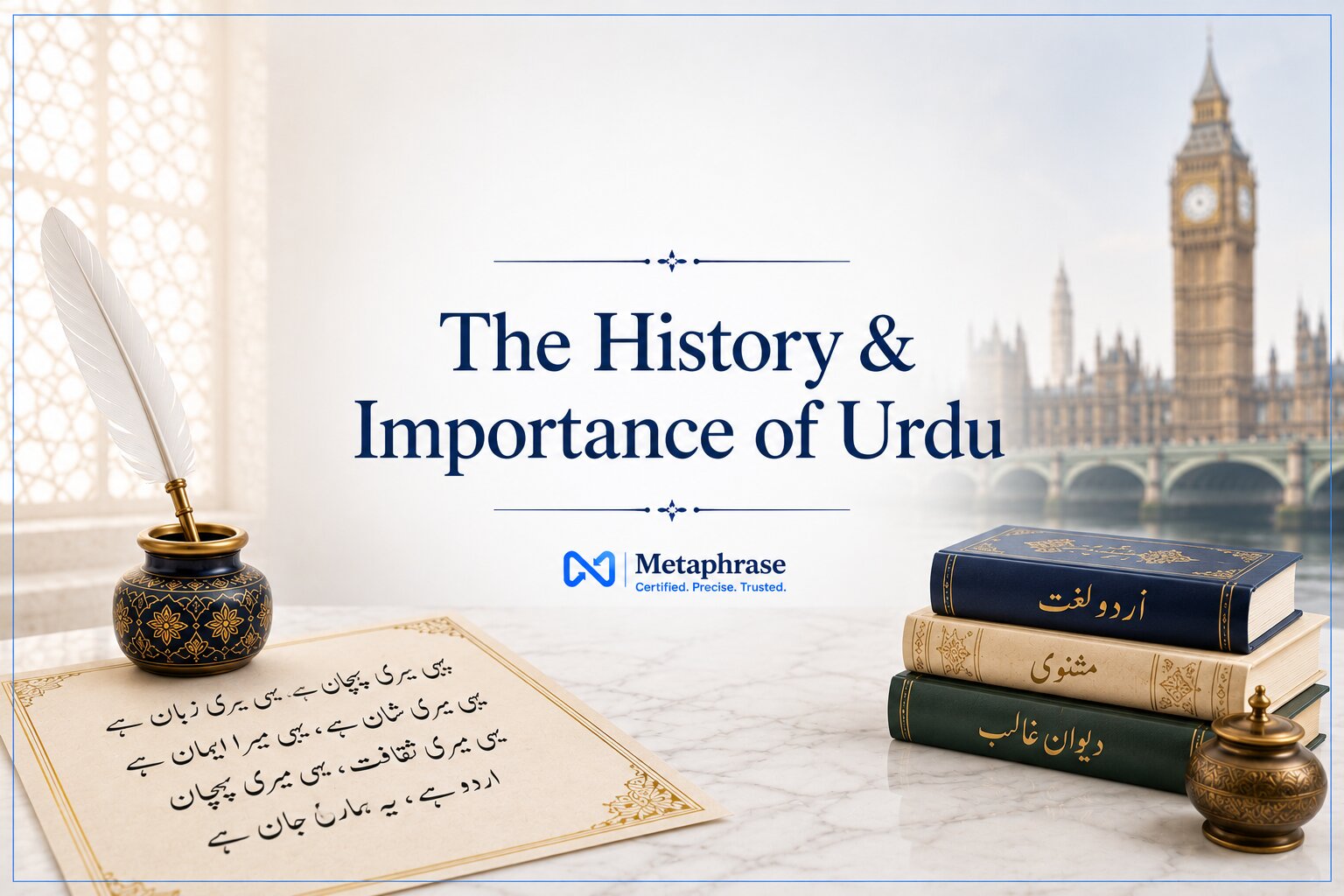
Urdu is spoken by over 230 million people and carries centuries of poetry, literature, and cultural heritage. This article explores the origins of Urdu, the elegant Nastaliq script, the language's role in Pakistan and India, and why specialist certified translation is essential for UK institutions.
Read the Article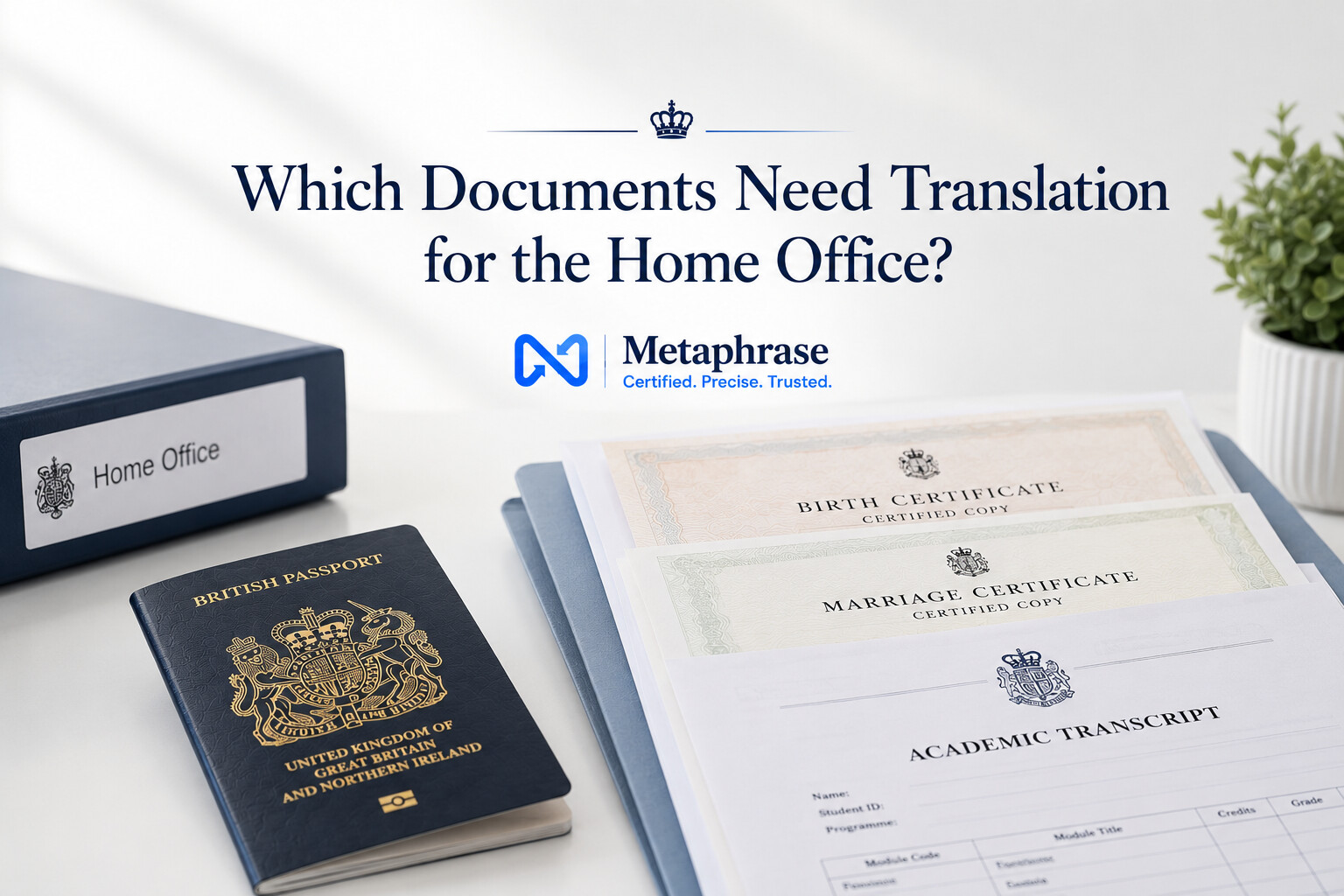
If you are submitting Urdu documents to the Home Office or UKVI, understanding the exact requirements for certified translation is essential. This guide covers what UKVI caseworkers look for, why machine translation is always rejected, and the documents most commonly required in Pakistani immigration applications.
Read the ArticleGet a free, no-obligation quote. Accepted by UKVI, the Home Office, UK courts, universities, and the NHS. Turnaround from 24 hours.