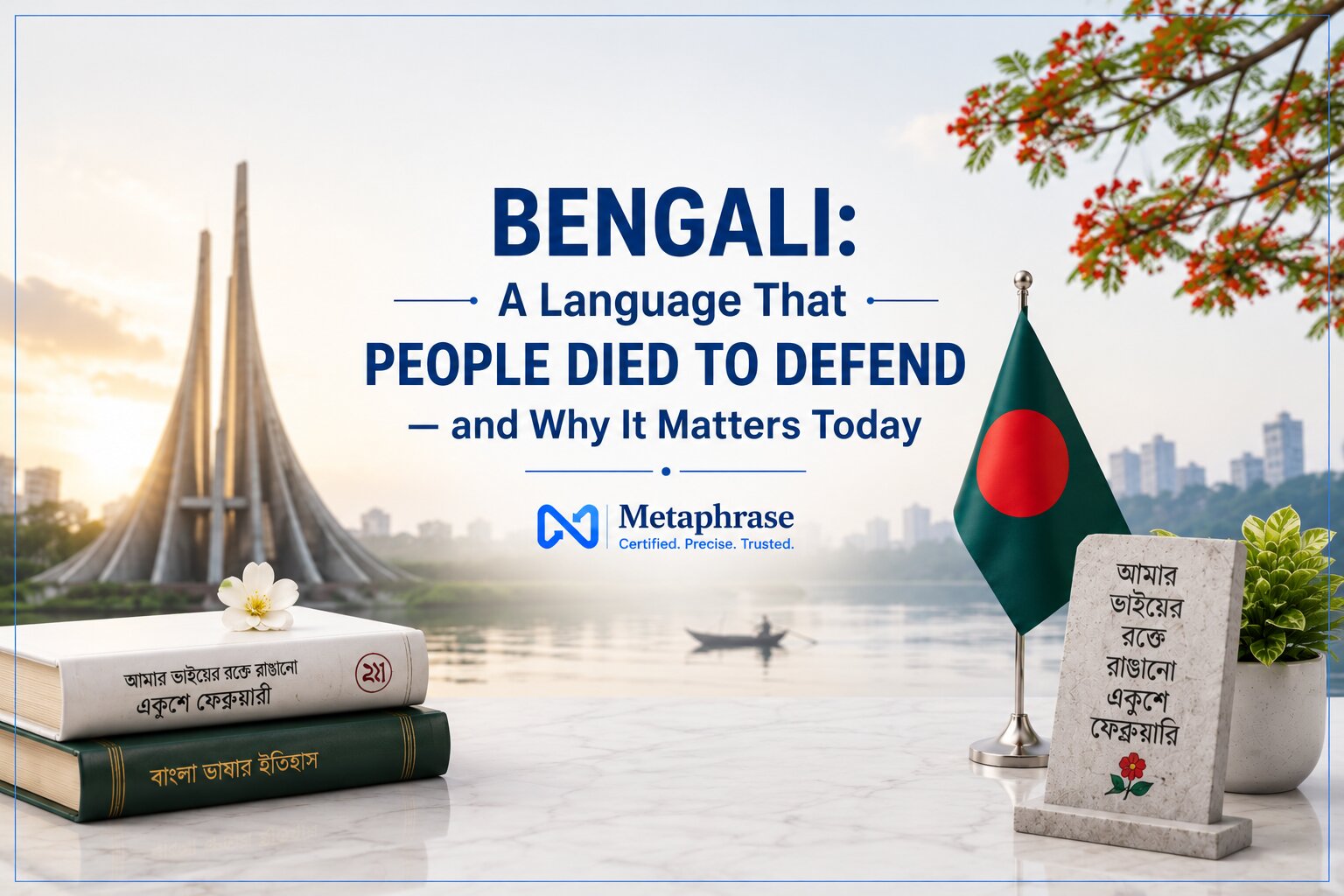
There are roughly 7,000 languages spoken on Earth. Most of them drift through history quietly, shaping the lives of those who speak them without ever demanding acknowledgement from the wider world. Bengali is different. It is one of the few languages for which people took to the streets, faced armed security forces, and in some cases lost their lives — not because of political ideology, territorial dispute, or economic grievance, but simply to defend the right to speak their mother tongue.
That event — the Language Movement of 21 February 1952 — is the reason the United Nations now marks International Mother Language Day every year across the world. Bengali is the only language with a day commemorated in its honour at the global level. That fact alone tells you something important about what Bengali means to the people who speak it.
Origins: A Thousand Years in the Making
Bengali belongs to the Indo-Aryan branch of the Indo-European language family — the same broad lineage that includes Hindi, Urdu, Punjabi, Marathi, and Sanskrit. Its earliest literary forms emerged between the 10th and 12th centuries in what are known as the Charyapada — mystical Buddhist devotional poems discovered in Nepal in 1907, recognised as the oldest surviving Bengali literary texts.
The Bengal region has for centuries been one of the most culturally and intellectually fertile parts of South Asia. Situated in the delta where the Ganges and Brahmaputra rivers meet the Bay of Bengal, it was a hub of trade, scholarship, and religious thought — drawing influences from Hindu, Buddhist, and Islamic traditions over the course of its history. All of these threads wove themselves into the language.
By the 14th and 15th centuries, Bengali had a substantial literary corpus. The medieval period produced Mangalkavya — long narrative poems dedicated to folk deities — alongside devotional Vaishnava poetry celebrating the love story of Radha and Krishna. These weren't written for courts or scholars. They were sung in villages and recited at festivals, which is why Bengali survived and deepened its roots so effectively: it was always a language of the people, not just the elite.
Under the Mughal period and later British colonial rule, Bengali continued to evolve. The 19th century Bengal Renaissance brought a wave of reformist thought, education, and literary innovation that fundamentally shaped modern Bengali and positioned Calcutta (Kolkata) as one of South Asia's great intellectual centres.
The Bengali Script: বাংলা লিপি
One of the most immediately striking things about Bengali is its script — visually distinctive, curvilinear, and entirely its own. The Bengali script evolved from the ancient Brahmi writing system, taking its modern form over the course of the second millennium. It is closely related to the Assamese script, and more distantly to Devanagari (used for Hindi and Sanskrit), but it has its own unique character set and aesthetic.
The script is written left to right — unlike Urdu or Arabic — and features a distinctive horizontal line (called the matra) running along the tops of letters, visually linking words together. Bengali has 11 vowel letters and 39 consonants, with a complex system of combined characters called juktakkhar that fuse two or more consonants into a single form. These combinations are one reason Bengali requires genuine specialist knowledge to translate accurately from original documents — the merged characters can be misread even by those with only partial familiarity with the script.
For UK institutions and immigration authorities, this matters practically: official Bangladeshi documents — birth certificates, Kabinnamas, academic transcripts, police clearances — are written entirely in the Bengali script. A translator without genuine reading fluency in that script cannot produce a reliable certified translation, no matter how fluent they may be in spoken Bengali.
Tagore, Literature, and the Bengali Cultural Inheritance
Bengali literature is one of the richest in the world. That is not hyperbole — it is a statement backed by a Nobel Prize, an extraordinary oral and written tradition spanning a thousand years, and two national anthems. The national anthem of Bangladesh (Amar Shonar Bangla) and the national anthem of India (Jana Gana Mana) were both written in Bengali by the same person: Rabindranath Tagore.
Tagore is the towering figure of Bengali literary culture. A poet, novelist, playwright, composer, philosopher, and painter, he was awarded the Nobel Prize in Literature in 1913 — the first Asian ever to receive the honour. The Nobel committee cited his verse collection Gitanjali (Song Offerings), which he translated from Bengali into English himself. The collection moved Western readers precisely because it expressed something universal through something deeply rooted in Bengali sensibility: devotion, longing, the relationship between the human and the divine, expressed with clarity and restraint.
"Where the mind is without fear and the head is held high; Where knowledge is free…" — Rabindranath Tagore, from Gitanjali (1913). Originally written in Bengali. The Nobel Prize in Literature was the first ever awarded to an Asian writer.
Beyond Tagore, Bengali literature encompasses centuries of diversity: the devotional poetry of Chaitanya's Vaishnava tradition; the folk epics and ballads of the Baul mystics; the sharp social realism of Sarat Chandra Chattopadhyay; the revolutionary prose of Kazi Nazrul Islam, Bangladesh's national poet, who wrote against colonialism and religious division with equal passion. Bengali has always had writers who used the language to speak truth to power — which is part of what made the events of 1952 so extraordinary.
The 1952 Language Movement: The Day Bengali Bled
To understand why Bengali means what it does to people who speak it, you need to understand 21 February 1952.
When the British partitioned India in 1947, the new state of Pakistan was created in two disconnected geographic parts: West Pakistan (present-day Pakistan) and East Pakistan (present-day Bangladesh), separated by over a thousand miles of Indian territory. The two wings shared a religion — Islam — but little else. The population of East Pakistan was overwhelmingly Bengali-speaking. West Pakistan's dominant language was Urdu, spoken natively by a small minority even in the west but promoted as the language of elite governance and Islamic cultural prestige.
The martyrs of 1952 are remembered in Bangladesh through the Shaheed Minar — the Language Martyrs' Monument — which stands in Dhaka near the site of the original protest. Replicas exist in Bangladeshi diaspora communities worldwide, including in London. Every year on 21 February, Bangladeshi communities across the UK gather at local Shaheed Minars, laying flowers and reciting poetry in Bengali to commemorate the sacrifice.
This is not simply history. For British Bangladeshis — particularly those from the Sylheti-speaking communities who form the backbone of the UK's Bangladeshi population — the Language Movement is a living part of cultural identity. The idea that language is worth fighting for, that it is inseparable from dignity and selfhood, runs deep.
Standard Bengali and Sylheti: One Script, Two Worlds
One of the most important things to understand about Bengali in a UK context is the distinction between Standard Bengali and Sylheti — and why it matters for translation and communication.
Standard Bengali (called Shudho Bhasha in formal contexts or Cholitobhasha in everyday educated speech) is the official written and spoken language of Bangladesh and the Indian state of West Bengal. It is the language of government, education, media, literature, and all official documents. If you hold a Bangladeshi birth certificate, a Kabinnama, an academic transcript, or a police clearance certificate, it is written in Standard Bengali.
Sylheti is something quite different. It is a distinct dialect — some linguists argue it is a separate language in its own right — spoken in the Sylhet division of north-eastern Bangladesh and by Bangladeshi diaspora communities whose families originate from that region. That includes the majority of British Bangladeshis: the large communities of Tower Hamlets, Oldham, Bradford, Birmingham, and Luton trace their roots predominantly to Sylhet.
Sylheti and Standard Bengali are not mutually intelligible in the way that, say, Scottish English and received pronunciation are. The vocabulary, phonology, and grammatical structures diverge considerably. A Standard Bengali speaker encountering Sylheti speech will understand some of it — but not all, and not reliably. The reverse is also true. Many British Bangladeshis whose mother tongue is Sylheti are not fully fluent in Standard Bengali as a spoken language, even though they may be literate in the standard written form.
For translation purposes: all official Bangladeshi documents — the ones that need certified translation for UKVI, courts, and NHS — are written in Standard Bengali. Sylheti fluency alone is not sufficient to translate them accurately. Professional certification requires genuine competency in Standard written Bengali alongside an understanding of the Sylheti context that shapes many clients' documents and circumstances.
At Metaphrase, we work with CIOL-certified translators who understand both — ensuring that what is written in the formal register of official documents is translated accurately, and that the Sylheti background of most British Bangladeshi clients is understood and respected throughout the process.
Bengali in the United Kingdom
The Bengali-speaking community in the UK is one of the largest South Asian communities in the country. The 2021 Census recorded approximately 600,000 people of Bangladeshi heritage in England and Wales, with the true number of Bengali speakers (including West Bengalis from India) somewhat higher. The community is disproportionately concentrated in certain cities and boroughs: Tower Hamlets in east London has one of the highest concentrations of any ethnic group in any local authority area in the country, with around a third of its population identifying as Bangladeshi.
The story of the British Bangladeshi community is, in large part, the story of Sylheti migration. The first waves of Bangladeshi workers arrived in the UK in the 1950s and 1960s, drawn primarily from the Sylhet region by labour shortages in Britain's catering and garment industries. They were joined by family members through the 1970s and 1980s, and the community has continued to grow through family reunion and settlement pathways ever since.
Today, the British Bangladeshi community is established across multiple generations, with significant representation in business, law, medicine, academia, and politics. Rushanara Ali was the first Bangladeshi-origin MP elected to the UK Parliament. The community's cultural footprint — particularly in east London, with its restaurants, community centres, mosques, and the annual Baishakhi Mela festival — is nationally recognised.
Bengali remains widely spoken in British Bangladeshi homes and community institutions. For second and third generation British Bangladeshis, it is often a marker of cultural continuity — spoken with parents and grandparents, used in community prayer and cultural events, and passed on to children as part of a deliberate effort to maintain heritage. Sylheti specifically is the everyday spoken language of most British Bangladeshi families.
Why Certified Bengali Translation Matters in the UK
For the British Bangladeshi community, the need for certified Bengali translation arises most frequently in the context of immigration and family law. The UK's immigration system requires certified translations of virtually any document not originally in English: birth certificates, marriage certificates, divorce papers, academic qualifications, police clearances, financial statements, and identification documents must all be fully and accurately translated before they can be submitted to UKVI or the Home Office.
For Bangladeshi applicants, the specific documents involved carry their own linguistic and documentary challenges. The Kabinnama — the Islamic marriage contract used in Bangladesh — is one of the most complex documents we translate. It is a multi-page contract containing the details of both parties, the mahr (dower), conditions of the marriage, witness declarations, and the Kazi's (marriage registrar's) information, written in a formal Bengali register that incorporates Arabic and Urdu-influenced religious terminology. Older Kabinnamas — particularly those from rural areas of Sylhet, Chittagong, or Barisal — may be handwritten, with regional script variations that require careful attention.
Birth certificates from Bangladesh present their own challenges. The BDRIS (Birth Death Registration Information System) has been modernised in recent years, but many families still hold older certificates from Union Council registers — sometimes partially handwritten, sometimes with inconsistent formatting across different local authority areas. Knowing how these documents are structured, what each field means, and what the stamps and official seals represent requires practical experience with Bangladeshi bureaucratic documentation specifically.
Need Certified Bengali Translation?
UKVI-accepted, CIOL-certified, 24–48hr turnaround. Standard Bengali and Sylheti handled.
Key Documents: What Gets Translated and Why It Must Be Done Right
The consequences of a poor certified translation can be serious. In immigration, a translation that omits fields, misrenders names, or fails to include stamp text can result in a visa application being refused at the initial consideration stage. The applicant then faces the cost and delay of resubmitting — sometimes missing a visa appointment they cannot reschedule, or losing non-refundable application fees.
In legal proceedings — family court, immigration tribunals, employment cases — the stakes are higher still. A translation that misrepresents the terms of a marriage contract, the content of a court order, or the conditions of a financial agreement can have consequences that go beyond inconvenience. Judges and solicitors rely on the translator's certificate of accuracy as a professional guarantee of the document's content.
- Kabinnama (Islamic marriage contract) — the most frequently translated Bengali document for UK immigration purposes. Complex language, religious terminology, and often handwritten older versions.
- Birth certificates — from BDRIS or Union Council registers, ranging from modern computerised certificates to older handwritten registers.
- Academic transcripts and degree certificates — from institutions including Dhaka University, Shahjalal University, BUET, and affiliated colleges nationwide.
- Police character certificates — issued by the Bangladesh Police or Special Branch, required for settlement applications and certain visa categories.
- Divorce documents — talaq notices, court-issued dissolution orders, and civil registration records.
- Driving licences — for DVLA exchange purposes, requiring accurate translation of all fields and endorsements.
- Passports and national identity documents — Bangladesh National Identity Cards (NID) are increasingly required for immigration documentation.
What all of these documents share is that they are written in Standard Bengali, in a formal register, with official stamps and seals that are themselves part of the translated content. Getting the translation right from the first submission is always less costly — in time, money, and stress — than having to redo it following a rejection.
Bengali is not a minority language in any meaningful sense. It is spoken by more than 270 million people, carries one of the great literary traditions of the modern world, and is the language of a vibrant, established community across the United Kingdom. It is also a language with a complex history of official varieties and dialect diversity that makes specialist expertise genuinely important rather than merely desirable.
If you need certified Bengali translation for an immigration application, a legal matter, an academic submission, or any other official purpose, the quality of that translation can make a real difference to the outcome. At Metaphrase, we provide certified Bengali translation services that are accepted by UKVI, the Home Office, UK courts, and universities — delivered by CIOL-certified professionals with direct expertise in Standard Bengali documentation.